


Last updated: June 2026
The GLP-1 Muscle Loss Problem (And How to Fix It)
Researched by Ian Douglass


GLP-1 medications have taken the world of weight-loss medications by storm, and it’s quite easy to see why. Medical reports reveal that at least 10 million adults have been prescribed GLP-1 in the United States alone, although survey results suggest that closer to 30 million adults in the U.S. are either presently taking one or more of the anti-obesity medications containing GLP-1 - like Ozempic, Wegovy, or Mounjaro - or they have already used them.
What’s more, the number of patients taking GLP-1 is only expected to grow in light of the drug’s effectiveness. Clinical trials of the GLP-1 medications show that users of the drug lost an average of 15-20% of their total body weight over the course of 72 weeks. (1) Outside of these clinical settings, millions of people have reported unprecedented weight loss success thanks to GLP-1.
Unfortunately, this unrivaled dietary phenomenon has a hidden side effect in the form of rapid muscle loss. Studies show that an average of 40% of the weight lost through the consumption of certain GLP-1 medications came in the form of lean body mass. (2)
of weight lost from GLP-1 medications comes from lean muscle mass, not just fat
This decrease in foundational muscle tissue would be a catastrophic downside for anyone. However, when you consider that GLP-1 is most frequently used by women between the ages of 50-64, and that post-menopausal women are already susceptible to the rapid loss of muscle mass, this particular drawback of GLP-1 use is most strongly magnified with its most frequent consumer group.
Breaking Down the Data
How GLP-1 Works
Decreases Hunger Signals
Suppresses appetite by affecting brain receptors that control hunger and satiety
Delays Gastric Emptying
Slows stomach emptying, making you feel fuller for longer periods
Promotes Rapid Weight Loss
The significant calorie deficit causes pounds to shed quickly - though not always from fat alone.
The problem of lean muscle mass is caused by multiple mechanisms of GLP1’s function. First, GLP-1 decreases the hunger signals sent by your brain, and boosts feeling of satiety, or satisfaction. Second, GLP-1 delays the emptying of food from your stomach, enabling you to feel fuller for a longer period of time.
Working in tandem, your mind and stomach send powerful signals that your body has consumed enough food - even when your actual calorie and protein intake has dropped dramatically. As a result, the body can begin shedding weight quickly, with little concern for whether that weight is coming from body fat or hard-earned muscle.
Under ordinary dieting conditions - especially when body recomposition is the goal - it is possible to maintain, or even build, lean muscle while eating fewer calories. With enough dietary protein and consistent resistance training, the body can still use protein to support new lean muscle tissue, even when calories are in shorter supply. (3) (4)
But GLP-1 medications can make that equation harder. Because appetite is significantly reduced, many people naturally eat less food overall - and with that, they often consume far less protein than their body needs to preserve lean mass. This is one reason why rapid weight loss on GLP-1 can come with an unwanted tradeoff: a meaningful loss of muscle. And that muscle matters.
In the long run, maintaining lean muscle is one of the keys to supporting a healthy metabolism and helping weight loss last. Each pound of lean muscle burns more calories per day than fat tissue, and studies have shown that muscle mass is one of the strongest predictors of resting metabolic rate - the number of calories your body burns at rest. (5)
That is why muscle loss during GLP-1 use should not be ignored. When lean mass declines, metabolism can slow, making it harder to maintain results once the medication is reduced or discontinued. And for aging adults who already struggle to maintain muscle, regained weight may be more likely to return as fat once normal calorie intake resumes.
by muscle tissue compared to fat tissue, making it essential for maintaining weight loss long-term.
The Perfect Solution: Creatine & HMB
Creatine Builds
- • Helps support strength and lean muscle during weight loss
- • Supports workout performance when calories are reduced
- • Clinically studied for strength, power, and lean mass support
HMB Protects
- • Reduces muscle protein breakdown
- • Protects muscle during calorie restriction
- • Boosts creatine’s benefits for strength, lean mass, and recovery
Fortunately, the world of sports supplements has a pair of natural remedies to reduce the likelihood of catastrophic muscle tissue losses caused by GLP-1 dosing.
Hydroxymethylbutyrate, commonly abbreviated to HMB, is a metabolite of the essential amino acid leucine, and is often prescribed as a medical intervention to prevent patients from losing muscle mass now that studies proved that it helps preserve muscle mass even when your body is in a state of catabolism. (6)
In hospital settings, HMB is commonly administered as an oral supplement in doses of 1.5 grams to preserve muscle mass, primarily in patients who have been stricken by illnesses that promote catabolism, or who are contending with conditions that have rendered them immobile.
Even when taken on its own, a compound like HMB - with muscle-preserving benefits that have been proven to the rigorous and exacting standards of countless medical institutions - is an ideal complement to a regimen of GLP-1. However, there is a second amino-acid-derived compound that can work synergistically with HMB to conserve an even larger share of muscle that might otherwise be lost during treatment with GLP-1.
For GLP-1 patients, especially those that train, creatine can work synergistically with HMB to ensure that a minimal amount of lean muscle tissue is lost as a consequence of GLP-1 intake.
First, creatine draws water into your muscle cells, which boosts their hydration level and enables them to retain their volume. This is beneficial for the sake of maintaining the appearance of muscle fullness, but is simply the tip of the iceberg with respect to the helpfulness of creatine inside of your body.
If you’re regularly engaging in resistance training, it has been proven in countless studies that creatine can accelerate the growth of lean muscle mass by optimizing muscle-protein synthesis. (7) Of course, this process is further improved by boosting your intake of protein, which means that prioritizing protein consumption during GLP-1 intake is also important. (8)
Finally, since neither creatine nor HMB is metabolised within your body for energy, they are essentially zero-calorie supplements that enable you to maximize your muscle-preserving potential. This elevates their attractiveness to GLP-1 patients whose priority is to minimize caloric intake.
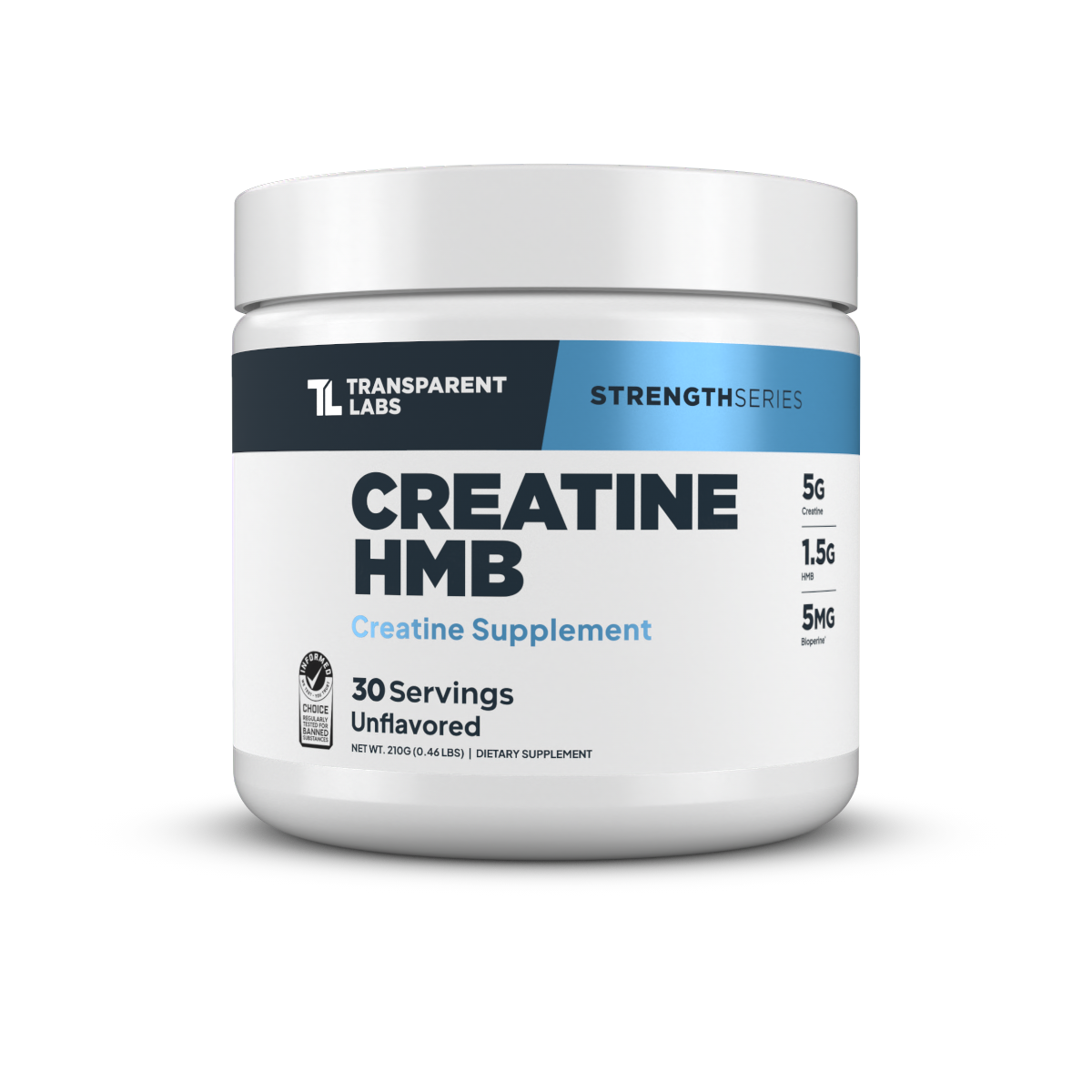
Transparent Labs Creatine HMB: The Perfect GLP-1 Partner

Transparent Labs
Creatine HMB
- Clinically dosed Creatine + HMB combo backed by research
- Designed to help you build and protect lean muscle during GLP-1 weight loss
- Support energy and strength when training
- Clean, zero sugar formula with only 5 calories per serving
Shop Now
Transparent Labs
Creatine HMB
- Clinically dosed Creatine + HMB combo backed by research
- Designed to help you build and protect lean muscle during GLP-1 weight loss
- Support energy and strength when training
- Clean, zero sugar formula with only 5 calories per serving
Shop Now
If you are looking to protect your hard-earned lean mass while on a GLP-1 journey, Transparent Labs Creatine HMB was formulated to offer you a clean, clinically dosed formula.
The bottom line is: GLP-1 medications can be powerful tools for weight loss, but much of that reduction in body weight can come from lean muscle loss. Protecting your hard-earned muscle and metabolic health requires strategy - and that includes resistance training, consistent nutrition, and targeted support from ingredients like creatine and HMB to help you approach your GLP-1 journey with a more complete plan.
Shop Now
Recommended GLP-1 Muscle Support
Transparent Labs Creatine HMB
Build and protect lean muscle during weight loss.
Starting at
$44.99
Sources:
Jastreboff AM, Aronne LJ, Ahmad NN, Wharton S, Connery L, Alves B, Kiyosue A, Zhang S, Liu B, Bunck MC, Stefanski A, for the SURMOUNT-1 Investigators. Tirzepatide Once Weekly for the Treatment of Obesity. N Engl J Med 2022;387:205-216. DOI: 10.1056/NEJMoa2206038.
Bikou A, Dermiki-Gkana F, Penteris M, Constantinides TK, Kontogiorgis C. A systematic review of the effect of semaglutide on lean mass: insights from clinical trials. Expert Opin Pharmacother. 2024 Apr;25(5):611-619. doi: 10.1080/14656566.2024.2343092. PMID: 38629387. https://pubmed.ncbi.nlm.nih.gov/38629387/
Helms ER, Spence AJ, Sousa C, Kreiger J, Taylor S, Oranchuk DJ, Dieter BP, Watkins CM. Effect of Small and Large Energy Surpluses on Strength, Muscle, and Skinfold Thickness in Resistance-Trained Individuals: A Parallel Groups Design. Sports Med Open. 2023 Nov 2;9(1):102. doi: 10.1186/s40798-023-00651-y. PMID: 37914977; PMCID: PMC10620361.
Longland TM, Oikawa SY, Mitchell CJ, Devries MC, Phillips SM. Higher compared with lower dietary protein during an energy deficit combined with intense exercise promotes greater lean mass gain and fat mass loss: a randomized trial. Am J Clin Nutr. 2016 Mar;103(3):738-46. doi: 10.3945/ajcn.115.119339. Epub 2016 Jan 27. PMID: 26817506.
Gitsi E, Kokkinos A, Konstantinidou SK, Livadas S, Argyrakopoulou G. The Relationship between Resting Metabolic Rate and Body Composition in People Living with Overweight and Obesity. Journal of Clinical Medicine. 2024; 13(19):5862. https://doi.org/10.3390/jcm13195862
Deutz NE, Pereira SL, Hays NP, Oliver JS, Edens NK, Evans CM, Wolfe RR. Effect of β-hydroxy-β-methylbutyrate (HMB) on lean body mass during 10 days of bed rest in older adults. Clin Nutr. 2013 Oct;32(5):704-12. doi: 10.1016/j.clnu.2013.02.011. Epub 2013 Mar 4. PMID: 23514626.
Kreider RB, Kalman DS, Antonio J, Ziegenfuss TN, Wildman R, Collins R, Candow DG, Kleiner SM, Almada AL, Lopez HL. International Society of Sports Nutrition position stand: safety and efficacy of creatine supplementation in exercise, sport, and medicine. J Int Soc Sports Nutr. 2017 Jun 13;14:18. doi: 10.1186/s12970-017-0173-z. PMID: 28615996; PMCID: PMC5469049.
Cribb PJ, Williams AD, Stathis CG, Carey MF, Hayes A. Effects of whey isolate, creatine, and resistance training on muscle hypertrophy. Med Sci Sports Exerc. 2007 Feb;39(2):298-307. doi: 10.1249/01.mss.0000247002.32589.ef. PMID: 17277594.