


Food Temperature and Metabolism: Does It Matter?
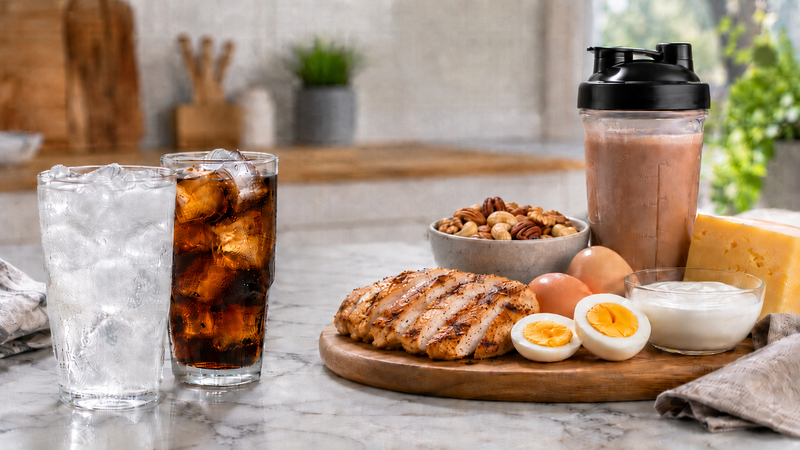
Every so often, someone will present you with a source of data either hinting or outright declaring that you can hack your body’s calorie-burning abilities by preparing your food in such a way that it elicits an unexpected metabolic response.
One of the statements that will eventually get uttered to you is the notion that the temperature of your food or beverage forces your body to work harder to digest it in a way that can be measured in expended calories.
This concept is often offered as a low-effort strategy for reducing the amount of fat on your body, but is it really that simple? Nutrition and training aside, is the key to six-pack abs really found through subtle tweaks in the temperature of your food?
Temperature of Drinks
One of the revelations that kickstarted the belief that food temperature could be the secret to fat-burning was the detail that ice water burned calories. As just one example of this, a May 1995 issue of The Vancouver Sun explained that “you burn 200 calories of metabolic heat to return ice water to normal body temperature.”
If true, the implications of this information would be staggering. After all, with only 150 calories in a 12-ounce can of Pepsi, the process of drinking that Pepsi while it was ice-cold would theoretically create a caloric deficit. This knowledge would be sufficient information to erect a nutrition strategy around soda drinking… if it was true, of course.
Misunderstanding Scientific Terms
If you’re among the millions of people who have gained undesirable body fat from the overconsumption of cold sodas, you know this can’t possibly be right, and it isn’t. This misconception was seemingly born out of the poor translation of data from the scientific world into the mainstream.
What most of us refer to as a calorie is actually a kilocalorie; 1,000 small-unit calories form a single kilocalorie, which is the calorie that you see displayed on the nutrition labels of your favorite food products. As such, the number of calories that could potentially be burned through drinking cold beverages was drastically inflated when it was mistranslated for public disclosure.
At this point, it is universally agreed that the number of calories that can be burned by drinking a glass of cold water, soda, or juice might be as high as eight calories, which is admittedly greater than the amount of calories burned through consuming food and drinks that are closer to the temperature of your body. Still, this is a far cry from hundreds of calories, and certainly not a data point to build a nutrition plan around.

What foods really burn calories?
The feature of food that seems to be the most exploitable in terms of how you plan around your body’s metabolic response system is the food’s macronutrient content. Specifically, while all food has a thermic effect, protein’s thermic effect is the greatest. Up to 30 percent of the calories contained within protein are burned during the digestion process, as opposed to calorie losses of up to 15 percent from carbohydrates, and three percent from fat.
Rationally speaking, if you’re already supplementing with heaping helpings of protein, this knowledge of protein’s heightened thermic effect probably won’t register within your top five reasons for consuming it. Chances are, you’re far more interested in protein for its tissue-repairing and muscle-building capabilities, or even its tendency to induce a greater sense of satisfaction, which can also lead to a reduction in the total calories you’re consuming.
With that being said, you can add the thermic effect of protein as just one more reason why you should prioritize its consumption whenever possible, as it forces your body to work harder during its digestive process. However, you should keep in mind that protein’s self-negating ability really only applies to the protein calories when you’re picturing how it works. In practice, when you eat a source of protein like cheese, the protein and fat content have separate thermic effects.
So while you might burn away 30 percent of the calories from the cheese’s protein content during the digestion process, the calories from the cheese’s fat content will max out at a three percent elimination rate during digestion.
Logical food hacks
When it comes to food hacks, if something sounds too good to be true, then it probably is. Realistically, no simple food or drink selection is going to wipe out an entire small meal’s worth of calories with minimal perceived effort. However, it just so happens that if you find yourself consuming the advised quantity of protein for the major benefits associated with those choices, you shouldn’t be surprised to find yourself on the receiving end of a few added enhancements as a bonus for making wise decisions.
Key Takeaways
-
The temperature of food is often cited as a low-effort strategy to build a nutrition plan around.
-
While this would be beneficial if true, this idea is born out of the difference in the way the word calorie is used by the scientific community and the general public.
-
A far more reliable indicator of how many calories are burned through digestion is found by analyzing foods’ macronutrient content, with protein having the highest thermic rate.
-
Even though you are unlikely to select food based solely on its thermic rate, it is one of several positive byproducts of engaging in a high-protein diet.
Featured Product


