


Think You Don’t Need Water for Strength Training? Think Again.
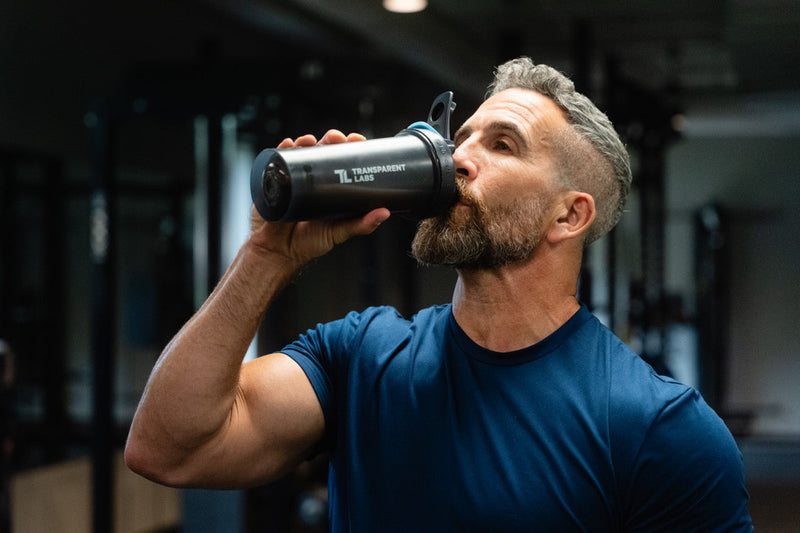
If you’ve participated in any sustained aerobic activities, or any sporting events lasting 30 minutes or more, you’ve probably felt the pangs of thirst gnawing at you, and also experienced the unfortunate decline of your body’s physical potential as fluids continue to retreat through your pores.
You’re also probably far more likely to approach your cardiovascular workouts with a water bottle in hand to quickly quench your thirst into a state of remission. However, your weightlifting activities always seem to induce far less sweat than other types of exercise, leading you to believe that you’re losing negligible amounts of fluids, and suffering no decline in performance while controlling weights against the force of gravity.
So how much is your refusal to hydrate hindering your muscle crafting efforts, and exactly how important is it for you to hydrate during your strength training activities?
Muscle Endurance
A study of experienced, strength-trained athletes indicated that there was a serious reduction in strength when 2.5 percent to 5.0 percent of their body fluids were lost prior to resistance training sessions. The study also exposed the pernicious nature of the strength loss, as it was not immediately discernible.
In other words, there was no obvious loss of strength when comparing set-one performances across strength training workouts. However, there was a significant drop-off in strength as the sets continued, being immediately evident at the outset of the second set.
The takeaway here is that you might be able to crank out a quality first set on the weights and believe that your lack of fluids is not compromising your performance in any way. However, if you begin your workout in an already dehydrated state, you can expect a drastic dropoff in strength as your workout continues.
Isometric Muscle Strength
A different study measured the total daily intake of water, and contrasted it with levels of human grip strength. The study found that those who hydrated with greater regularity enjoyed higher levels of grip strength on average once all other influential factors were accounted for.

While isometric strength often goes underappreciated, you definitely notice it during exercises like deadlifts, planks, or push-ups where muscle control is required to maintain a steady position. Therefore, if you refrain from hydrating yourself adequately, you may also find that your ability to stabilize a weight against consistent pressure has been sharply reduced.
Peak Power
In a study of two groups of strength-trained women — both of which were dehydrated, but one of which was given an opportunity to replenish its liquids prior to lifting — the dehydrated group experienced a significant decline in its average one-rep max on the bench press.
This is an indication that peak power is also significantly downgraded due to dehydration and a failure to recover fluids. So, even if your strength training workout is geared more toward generating explosiveness, and consists of just a few bursts of muscle power, you can expect that power to sit well beneath its peak potential if you engage in that training without ample fluids on hand.
Fluid Over Everything
The bottom line here is that if you think you can skate through your strength workouts in a dehydrated state without your body suffering any ill effects, you’re sorely mistaken. With this in mind, please do your best to begin your workouts with your body fully hydrated, and come prepared with water or some other rehydration solution on hand to preserve your fluids at an optimal level before your strength training workout even commences.
Summary
-
Lifting weights in a dehydrated state results in a rapid dropoff of muscle endurance.
-
The decline in muscle strength and endurance during dehydration also applies to grip strength and to exercises requiring you to stabilize and control a weight.
-
A loss of fluids can also be reflected in lowered levels of peak power compared with muscle performance when in a state of optimal hydration.
-
The advisable approach to strength training is to begin workouts in a state of full hydration, and to quickly replenish lost fluids.
Featured Product


