


How Much Protein Do You Need (Daily Breakdown)
With protein taking center stage as the “it” macro, people are wondering how much protein they need to stay healthy, build muscle, or improve longevity outcomes. While there are many factors in determining how much protein someone should consume daily, there seems to be a case to be made for a variety of macro breakdowns.
Your age, activity level, and starting point are a few factors that may influence your daily protein needs. The key is to find what will best support you toward reaching your personal goals.
Why Daily Protein Intake Matters
It seems they’ve added protein to everything. It's in sodas, ice cream, cereal, bars, shakes, and coffee. While it may seem overemphasized, protein plays an important role in your system's function. Protein is the only macronutrient that directly delivers amino acids, which are the raw materials your body uses to repair and build skeletal muscle tissue, which leads to muscle growth. That repair process, known as muscle protein synthesis (MPS), gets triggered by resistance exercise and amino acid availability from dietary protein, two primary stimuli.
According to the International Society of Sports Nutrition (ISSN) Position Stand on protein and exercise, the combination of resistance training and protein ingestion has a synergistic effect on MPS. ISSN also recommends acute protein doses of 20 to 40 grams to maximally stimulate MPS, ideally containing 700 to 3,000 mg of leucine.
Your body doesn't stay in a constant state of muscle growth, though. MPS and muscle protein breakdown cycle throughout the day — when MPS consistently exceeds breakdown over weeks, you gain muscle; when it doesn't, you lose it. Total daily protein intake can be a main factor as to which way the scale tips.
Protein has the highest thermic effect of food (TEF) among the three macronutrients, which changes metabolic output. Science shows that roughly 20 to 30 percent of the calories in protein are burned during digestion alone, compared to about five ot ten percent for carbohydrates and zero to three percent for fat. That makes protein a metabolically favorable choice regardless of whether you're in a surplus, at maintenance, or in a deficit. And because protein is the most satiating macronutrient gram-for-gram, eating enough of it helps manage hunger, which is beneficial for anyone in a calorie deficit.

Calculating Your Protein Needs by Goal
The "right" amount of daily protein will vary by person and goal. A person trying to add muscle mass in a caloric surplus has different needs than someone pursuing body recomposition or in a fat-loss phase.
For Building Muscle (Hypertrophy)
Target range: 1.6 to 2.2 g/kg/day (approximately 0.73 to 1.0 g/lb/day)
The landmark study is the 2018 meta-analysis, which pooled data from 49 randomized controlled trials and 1,863 participants. The finding: protein supplementation significantly increased fat-free mass during resistance training, with a statistical breakpoint at about 1.62 g/kg/day. Past that point, the pooled data didn’t show additional gains in lean mass. But the 95 percent confidence interval stretched up to 2.2 g/kg/day, which is where most practical recommendations cap out.
Research aligns with this, recommending 1.4 to 2.0 g/kg/day for anyone training and aiming to build or maintain muscle. And a 2022 meta-analysis by Nunes et al., covering 74 RCTs, confirmed that intakes at or above 1.6 g/kg/day produced the most consistent lean mass gains in younger, resistance-trained subjects.
If you’re lifting and eating at or above maintenance, aiming for about 0.8 to 1.0 grams per pound of body weight covers this range and keeps the math simple. It’s also best to split it up throughout the day, as research is still ongoing about how much protein your body can absorb in one sitting.
For Fat Loss and Body Recomposition
Target range: 2.3 to 3.1 g/kg of fat-free mass/day, or roughly 1.0 to 1.3 g/lb of total body weight for most people
When you're eating in a caloric deficit, your body becomes more willing to break down muscle tissue for energy, and protein intake is the primary nutritional way to counteract the process. ISSN stance on diets and body composition notes that higher protein intakes—specifically 2.3 to 3.1 g/kg of fat-free mass per day—may be necessary to maximize muscle retention in lean, resistance-trained individuals under hypocaloric conditions.
A 2016 randomized trial found evidence of this. Young men were placed in a significant caloric deficit (40 percent below maintenance) and assigned to either a higher-protein group (2.4 g/kg/day) or a lower-protein control group (1.2 g/kg/day) while performing resistance training combined with high-intensity interval training six days per week. After four weeks, the higher-protein group gained 1.2 kg of lean mass and lost 4.8 kg of fat. The lower-protein group gained just 0.1 kg of lean mass and lost 3.5 kg of fat.
The deeper your caloric deficit, the higher your protein intake should climb to protect the muscle you've built. If you’re looking to build an entirely different physique, it may be helpful to use a guide to body recomposition that covers calorie cycling, training needs, and macro targets.
For General Health and Maintenance
Target range: 1.0 to 1.6 grams of protein per kilogram of body weight per day
Recently, the United States Government reorganized the food pyramid, with protein at the base. The reevaluation came as the government pushes for a healthier population and urges citizens to prioritize real, whole foods. Their recommended daily allowance (RDA) is to target 1.2 to 1.6 grams of protein per kilogram of body weight per day.

For moderately active adults who aren't specifically pursuing hypertrophy or dramatic changes in body composition, research suggests that a range of 1.0 to 1.2 g/kg/day supports maintenance of lean mass and overall metabolic health. Even if you're not counting macros or following a structured training program, consistently eating below 1.0 g/kg/day may leave you under-recovered and under-satiated, and you may gradually lose muscle mass you'd rather keep. This becomes particularly important for aging adults.
Protein Recommendations by Body Weight (The Simple Breakdown)
Here's a reference table that puts the per-kilogram ranges into real daily gram targets. Find your approximate body weight and read across to your goal.

*The fat loss range here uses total body weight for simplicity. Individuals with higher body fat percentages may prefer to calculate based on lean body mass or on an estimated goal weight.
Factors That Influence Your Requirement
While protein is overall an extremely important macronutrient, your age, activity level, goals, the quality of protein, and your goals will all factor in to what makes sense for you.
Age: As you get older, your muscles become less responsive to amino acid stimulation—a phenomenon researchers call "anabolic resistance." One study found that increasing age reduced the effectiveness of protein supplementation on FFM gains during resistance training. Older adults, roughly 65 and above, tend to benefit from larger per-meal protein doses, closer to 0.40 g/kg per meal, compared to the 0.25 g/kg that's typically sufficient for younger adults to reach the MPS threshold. If you're over 50 and lifting, erring toward the higher end of any recommended range is reasonable.
Activity level and training status: Someone training five or six days a week with progressive overload is breaking down and rebuilding far more muscle tissue than someone who walks a few times a week. Resistance-trained individuals have demonstrated higher rates of protein turnover, meaning they consume amino acids more quickly than untrained individuals. The ISSN notes that trained individuals respond more favorably to protein supplementation than beginners. Endurance athletes who are runners, cyclists, or swimmers also carry elevated needs because prolonged aerobic exercise increases amino acid oxidation during the session itself.
Protein quality: Not all protein sources deliver amino acids in the same proportions or at the same speed. It is recommended that each protein feeding contain 700 to 3,000 mg of leucine, the amino acid that most potently stimulates MPS.
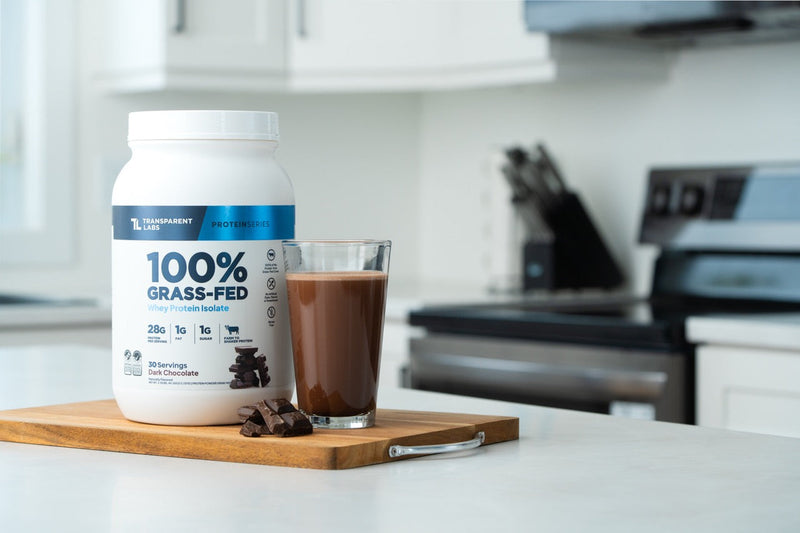
Whey protein isolate has one of the highest sources of leucine per gram of protein, which is one reason it outperforms other sources in acute MPS studies. Look for a high-quality grass-fed whey isolate sourced from grass-fed cows with no artificial sweeteners, fillers, or protein spiking.
How to Hit Your Goal: Practical Examples
Here are two at-a-glance snapshots of daily protein intake for two very different people with varying goals.
Example 1: Female Strength Athlete, 35, 145 lbs (66 kg) — Goal: Gain Mass
Daily target: ~140 g protein (~2.1 g/kg) | Slight caloric surplus, training 5x/week

Example 2: Male, 47, 220 lbs (100 kg) — Goal: Body Recomp (Target: 200 lbs)
Daily target: ~220 g protein (~1.0 g/lb) | Moderate deficit, high protein to offset anabolic resistance at 47

In both examples, protein shows up consistently throughout the day, not in one or two giant sittings. This tracks with the ISSN’s recommendation for evenly distributed feedings to sustain MPS across your waking hours. The 47-year-old needs more total grams and an extra meal to get there, but the principle doesn’t change.
Summary — Finding Your Sweet Spot
The question "how much protein do I need?" has a different answer depending on your body weight, training goal, and a few variables, such as age and activity level. But the research gives us clear bumpers.
If you're lifting to build muscle in a caloric surplus or at maintenance, the evidence-backed range is 1.6 to 2.2 g/kg/day (0.7 to 1.0 g/lb). If you're in a body recomposition, pushing toward 2.0 to 2.6 g/kg/day (1.0 to 1.2 g/lb) gives you the best shot at holding onto your muscle while you cut fat. And if you're moderately active and focused on general health, 1.0 to 1.2 g/kg/day keeps you well above the bare-minimum RDA.
Use the body-weight table above as your starting reference, track your intake for a week or two, and adjust based on how you feel, how you're recovering, and whether the scale and mirror are moving in the direction you want them to.
For anyone who finds it difficult to hit their number with whole foods alone—especially during a cut when appetite drops, and total calories are limited—a clean protein supplement without artificial additives or fillers can help you hit your protein goals efficiently, without extra junk on the label. And as always, if you have questions or concerns about your protein intake, it’s best to consult your health care provider for the best individual protocol.
Featured Product


